
Without question March Madness is my favorite time of the year. I’m far from a die-hard college basketball fan, but a number of features of March Madness turn it from your run-of-the-mill postseason tournament into an earth-shattering spectacle of awesome.
Collegeball: A True Underdog Story
If team A would beat team B nine out of ten times, team B is a massive underdog. Not only do people root for underdogs in general, but this effect is stronger in cultures where underdog stories are part of the national identity. The rags-to-riches story is called the “American” dream for a reason.
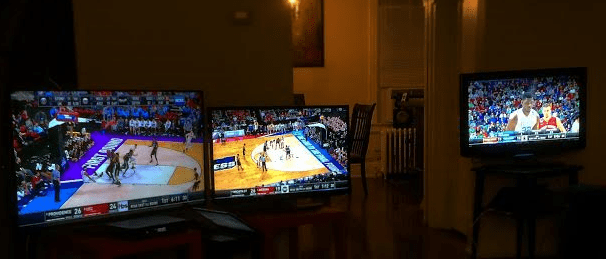
Especially in the first two days, there can be three to four different games on at the same time, and sometimes in the same room.
The number of games, the one and done format, and the subjective seeding process mean we invariably end up with thousands of upsets each year (rough estimate). When upsets occur, especially ones that bring us joy (e.g. #2 Duke losing to #15 Lehigh, #3 Duke losing to #14 Mercer, etc.) we remember them more strongly. This causes us to overestimate their likelihood1 of occurring in the future and view past March Madnesses through rose-colored glasses.
It also allows us to experience the cognitive dissonance of rooting for groups you would never otherwise root for. This year, two very unusual situations occurred:
- “A team from Yale” and “underdog” will repeatedly be used non-sarcastically in the same sentence
- Millions of non-Yale alums rooted for Yale to win something
Choosing who to root for between Yale and Duke isn’t quite choosing between being shot and poisoned (how Lindsay Graham recently described the choice between Donald Trump and Ted Cruz), but you just don’t find yourself doing so much outside the context of March Madness. We grow by placing ourselves in uncomfortable positions, and March Madness is a never ending source of personal growth.
The Gambling
The most accurate way to describe gambling in the short-term: extremely fun and/or infuriating. The most accurate way to describe it in the long-term: an ultimately destructive societal vice that acts as a regressive tax disproportionately affecting the poor, and—like tobacco, alcohol, firearms, and Chipotle—should be highly regulated and/or banned.
That said, filling out a bracket, having your results displayed on a public leaderboard2, and creating a better small talk topic than “the weather is hot/cold!” is incredibly fun. When you add in the relative lottery of winning your pool (e.g. bragging rights, a false belief that your own skill is responsible3) and the literal lottery of having a perfect bracket, the vividness with which you imagine winning, and the joy that brings you, far outpaces its likelihood of happening.
With 16 staggered games on each of the first two days, you are liberated from the shackles of the first half. A treat of college basketball is the ability to make dramatic comebacks when facing insurmountable-seeming deficits. The downside is that it renders the first half nearly meaningless. The sheer number of games ensures you can always flip to one in the waning minutes, many of which come down to the wire. Having a bracket and money on the line gives you a strong rooting interest in each game.
The commitment you feel to your bracket strengthens the better it does, and the public nature of the leaderboard can cause tensions to run high.4 Adding monetary incentives turns friendly competition into psychological warfare.
The Players’ Passion
These aren’t pro athletes rich beyond belief. These are college students, many of whom wildly overestimate their chances of playing professionally, and know their performance in the tournament will always be in the first paragraph of their wikipedia page—if they get one. They are kids, who have worked toward this moment for the majority of their conscious lives, and dreamt about it during their unconscious life. Professional athletes are undoubtedly more skilled, but you just don’t see them treating every possession like life-and-death, or breaking down into tears of anguish and/or unadulterated joy like a college kid does. This passion is contagious even through a TV screen.
Give in to the Madness
According to estimates which are themselves wastes of productivity, the US economy loses $1.9B worth of productivity during March Madness. Depending on how you define this post, my own productivity today has certainly been lost. Many view this is a needless sink on the US economy, but they are categorically wrong. Many of the greatest innovations were first conceived during March Madness, and it was while watching a particularly enthralling 12 over 5 upset that Leonardo da Vinci put the finishing brushstrokes on Mona Lisa’s smile.
March Madness is a national treasure and should be cherished.
Footnotes:
- This is known as the Availability Heuristic. Availability, as in, how easily available examples of something are when you try to bringing them to mind. Heuristic, as in, mental shortcut. The how available examples of something are when you try bringing them to mind mental shortcut causes us to overestimate the probability of rare, but spectacular, events.
- “Points, badges, and leaderboards are the holy grail of gamification,” was most likely said by someone somewhere, and its true–they tap into people’s need for social status, and can profoundly influence our behavior.
- This is called “THE Fundamental Attribution Error” (emphasis mine), it has to do with how we attribute credit for events, and it is fundamental because it relies on the fact that you are yourself, and not someone else. For example, if something bad happens to you, you assume its due to situational factors (“that teacher just doesn’t like me”), whereas if it happens to someone else, you are more likely to ascribe it to their character (“he spends too much time gambling on sports and not enough studying”)
- In this way, brackets are very similar to bumper stickers, the prevalence of which is the number one predictor of road rage, which is itself the number one predictor of car accidents.
 Intersections