
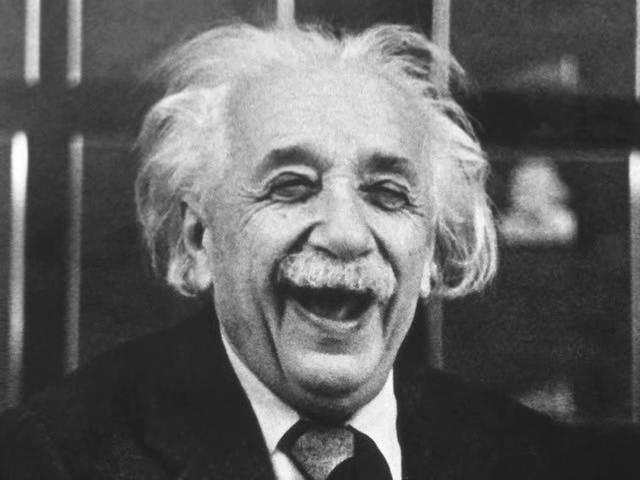
“Put your hand on a hot stove for a minute and it seems like an hour. Sit with a pretty girl for an hour, and it seems like a minute. That’s relativity”
Everything is Relative
Not only was he photogenic, but Einstein also articulated a number of timeless insights, such as the fact that everything in life is relative.
For example, having $100 can make you feel completely differently depending on the circumstances. It is a different feeling to end the day with $100 if you started with $0 than if you started with $200.1
It may seem obvious that we don’t evaluate things in a vacuum, but the idea that our reference points shape our outlook goes against traditional economic models, which view humans as perfectly “rational” decision-makers with consistent preferences.
Behavioral economics examines the factors that influence how people make decisions in the real world (as opposed to the fake world of economic models, which are notoriously bad at predicting the future).
In a set of classic experiments, Daniel Kahneman and Amos Tversky2 asked students to choose which lotteries they prefer, with questions such as:
Both lotteries have the same expected payout, so one might expect people to be indifferent between them. Were you?
How would your answer change if you started with $0? with $1,000,000? with a debt of $3,000?
Kahneman and Tversky learned that people will be irritated if you don’t enter them into any lotteries after asking them which of two they prefer, but the study also provided other insights, including that people’s preferences are much more complicated than economists had been giving them credit for.
Losing Sucks More than Winning Rocks
Among the findings from this research was the phenomenon of loss aversion: losses hurt more than gains feel good.
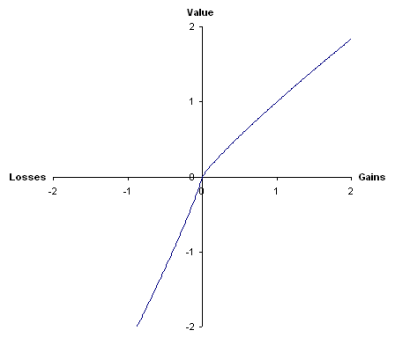
For the graphically inclined, this figure shows how much value we place on a gain compared to a loss. Notice that the slope of the line is steeper on the left (losses) than the right (gains). Starting at $0, you feel 2 units of pain when losing $1 compared to only 1 unit of happiness when winning $1.3
Why Do We Hate Losing? Because Evolution
From an evolutionary perspective, it is beneficial that we are averse to losses, and that they loom larger in our minds than gains. Being twice as cautious when faced with potential harm keeps us alive.
However, we often fail to consider this when making a decision, and only realize how painful losses are after we have experienced them.
This lack of foresight is the root of many common decision making pitfalls, and fully understanding it can help us make more effective decisions. Future blog posts will explore this in more depth.
Footnotes:
- This blog post uses money for the purposes of example, but the underlying insights are widely applicable to financial and non-financial decision making alike.
- Experiments are from their 1979 paper “Prospect Theory: An Analysis of Decision Under Risk,” which is often credited with launching the field of behavioral economics.
- On average, people hate losses twice as much as they love gains. This is a strong argument against gambling, unless the positive value you get from the thrill of a prospective gain overwhelms this. Studies show it probably doesn’t.


2 thoughts on “Einstein: The Father of Behavioral Economics”