

If you haven’t yet played Settlers of Catan, you are making a foolish mistake.
I was the fool until about 2 months ago, when I first settled the legendary land of Catan. This coincided with my girlfriend beginning a stretch of near constant work travel, creating a perfect storm resulting in me spending inordinate amounts of time placing plastic pieces on a dilapidated board.
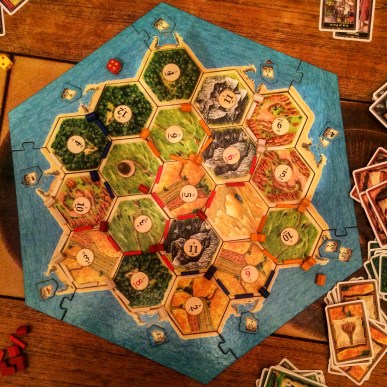
What is Settlers of Catan?
If you’re asking this question, it should be clear by this point that you are in the wrong place. Nevertheless (in a likely futile) attempt to make this relevant to those that have never played, Settlers of Catan is a German-style ~1 hour board game, where 3-4 players compete to get 10 victory points. They get victory points by building things, and they build things using resources, which are acquired based on the roll of the dice. Players can block each other from getting resources by using a “robber.”
I have always been a negotiation fan, so the most interesting part of the game to me is that players can trade with one another.
The following are some negotiation lessons I learned from Settling, to hopefully not be used against me by future opponents.
Expand the Pie
When trading resources with other players, it can be easy for the negotiations to break down when you can’t find a suitable 1 for 1 exchange. However, you greatly increase your likelihood of reaching a deal if you can find things other than what initially brought you to the table over which to trade. A personal favorite of mine is including a promise for one (or both) of the sides not to place the robber on each other the next time they move it. This makes the trade more of a win-win, but it also engenders a sense of goodwill, which brings me to my second tip.
Do Unto Other Settlers as You Would Have Them Do Unto You
In Settlers of Catan—and in life—the most important negotiations aren’t truly one time events. You still have to interact with your counterpart long after any single negotiation ends, and the tenor of every negotiation influences the relationship that follows. To increase the likelihood of success in future negotiations, it is always a good idea to build goodwill in advance of need. Think of goodwill like a bank that you build up and depletes when you use it. If you build goodwill only when you need it, it will do more harm than good.
Building goodwill can manifest through taking mercy on a struggling player with robber placement, making many trades early in the game, or even rationally explaining to someone you are robbing of resources exactly why you are doing it, so they don’t take it personally and seek retribution.
Reciprocity is among the most powerful “Weapons of Influence,”1and you should use it to your advantage.
**TIP SPONSORED BY LOSS AVERSION**
Given that this is a blog primarily about behavioral economics, I am almost contractually obligated to mention loss aversion in every post. In Settlers, the fear of losing is often stronger than the excitement associated with winning2. When trying to influence your opponent to do something (or not to do something), describing how the action will bring a someone else to victory is often a winning argument.
Framing your arguments in terms what others stand to lose gives you more credibility and makes you more convincing than framing arguments in terms of what they stand to gain.
Knowledge is Power

Information—what resources you have, what resources your opponents have, how close each side is to victory, potential designs on longest road or largest army, etc.—is a key source of power in a negotiation. Thus, the more information you can gain from your opponents, the better off you will be. Information can be gained through close observation (e.g. tracking which resources have been acquired by whom) but also by asking many questions. Research shows that the best negotiators ask twice as many questions as average negotiators. The more information you can gain, the better.
Similarly, you should be strategic about which pieces of information to reveal about your own position. For example, if you are approaching victory, be coy and lull your opponents into a false sense of security before pouncing when least expected with a devastating array of moves.
Turn deserts into oceans
Literally, the desert piece can easily be turned over, creating an ocean without any effect on the gameplay. There is a negotiation tip in there somewhere.
Footnotes
- Robert Cialdini coined the term “Weapons of Influence” in his incredibly influential book on influence, “Influence: Science and Practice.” The weapons of influence are: reciprocity, commitment and consistency, scarcity, liking, authority, and social proof.
- We fear losing about 2 times as much as we like winning, studies say.
 Intersections
Thanks for sending the along, my wonderful son!
LikeLike