

I am in a terrible mood because my favorite team—the New England Patriots—squandered the chance to advance to the Super Bowl for the second time in a row and the seventh time in my life.
The previous sentence epitomizes why nearly all sports fans hate the Patriots (and their fans). Nevertheless, sports fandom perfectly illustrates how difficult it is for a single event to affect one’s long-term happiness level1.
While I’m currently devastated, my minute-to-minute happiness tomorrow, and the next week, month and year won’t be significantly affected by this loss.

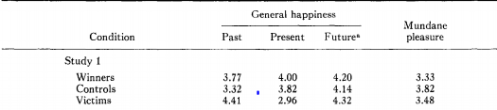
A commonly cited study2 shows that paraplegics feel worse about the present than do lottery winners. This is in line with how Patriots and Cardinals fans currently feel, especially compared to Broncos and Panthers fans. The former feel like garbage, the latter feel fantastic.
The part of the study that should make Patriots and Cardinals fans happy, though, describes how winners were worse at appreciating mundane daily pleasures than were paraplegic accident victims. Winning the lottery serves as an “extreme positive anchor” and everything that happens after it is compared to it at some level. Paraplegics had an extreme negative anchor that set a lower baseline happiness level and a worse reference point for future events, helping them derive more joy from mundane pleasures.
Moment-to-moment happiness is relative, so everything bad that happens makes daily life feel better by comparison, and everything good that happens makes it feel worse.
So, not only should mourning sports fans should realize that a single game won’t change their long-term happiness level, but everyone should realize that humans have a strong natural ability to adapt, and that very few events significantly influence your average happiness level.
In the long run, your moment-to-moment happiness is surprisingly stable.
Footnotes:
- The term “hedonic treadmill,” has been used to describe how happiness doesn’t go up much after significant life improvements, as there is still something to chase. The wikipedia page for it has an impressively targeted link, going specifically to the 3rd page of this 2000 NYT story.
- The study has been interpreted in many ways…what do you think is the most interesting finding?
 Intersections