

The Biweekly Bias is a regular feature in which I describe a common—but little known—cognitive bias, speculate on its evolutionary underpinnings, and give some tips for how to use it to your advantage.
Biweekly Bias: Autistic Hostility
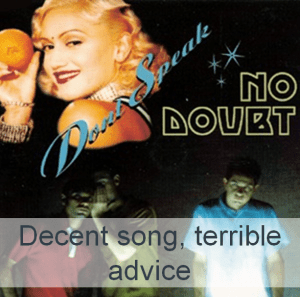
It turns out that the central recommendation Gwen Stefani made in the 1996 hit single, “Don’t Speak,” was not a very good one.
Picture the last time this happened: you’re texting back and forth, and all of a sudden, you send a message and get no response. We’ve all been there.1 After this exchange (or lack thereof), are you likely to feel positively or negatively toward the person on the other end? Does this make you more or less likely to communicate with the non-responder in the future?
If you answered “negatively” and “less likely,” then you—like most people—are falling prey to a relatively unknown cognitive bias: autistic hostility.2
Put simply, autistic hostility is when you don’t speak with someone for a long time, and assume the reason you haven’t talked is because one of you is mad. Put complicatedly, “the likelihood that a persistently hostile attitude will develop varies with the degree to which the perceived inter-personal relationship remains autistic, its privacy maintained by some sort of barriers to communication.”3
Why I Feel Irate When You Don’t Communicate
I operate with the assumption that most of our seemingly irrational cognitive biases were somehow advantageous at some point in human evolution. Let’s see how this could be the case for autistic hostility.
Human babies are completely helpless, depending entirely on their parents for survival for much longer than other species’ babies do. A human baby is unable to fend for itself in the wild, and thus benefits greatly when its parents stay coordinated in their care giving efforts.
If your significant other goes incommunicado, this is likely to create hostility, which people don’t like and are generally motivated to avoid (they are especially motivated to avoid it when the source of the hostility is a significant other4). The motivation to avoid hostility results in more frequent communication. Furthermore, autistic hostility means that your desire to communicate with the other person becomes an important selection criteria for a mate; if you don’t have this desire and thus communicate infrequently, feelings of hostility are likely to abound, making the relationship more likely to end before it reaches the child-bearing stage.
In an evolutionary sense, the purpose of life is to pass on your genes. Autistic hostility makes it more likely that when a child is born, it will be born to parents who communicate frequently with one another and can thus work together to attend to the needs of the child, increasing the likelihood that the child will survive to pass on his or her own genes.5
Silence Isn’t Golden
Provided that you want to prevent people from developing hostile attitudes toward you, recognize that more harm comes from not communicating enough than from communicating too much. When you stay silent, you create an opportunity for others to speculate about your opinions, thoughts, and motivations, and autistic hostility suggests they are likely to assume the worst. Here are two tips to avoid falling prey to this:
- Communicate when you’re going to communicate. If a someone (e.g. a client) asks you a question to which you don’t have the answer, a typical approach is to wait until you have the solution to respond—especially if the question comes in the form of an email. Given that hostile attitudes are likely to develop in the time between the question being posed and you responding, it can be a better approach to acknowledge that you’ve heard the concern, and let them know when you will be getting back with an answer.
- Avoid the “Silent Treatment.” A significant downside of autistic hostility is that it can become a self-fulfilling prophecy, turning a lack of communication that could have happened for a variety of reasons into real animosity. Many times, there is a legitimate reason to feel hostility toward someone. Where autistic hostility rears its ugly head is when this legitimate reason causes a break in communication. In the absence of actually speaking with the other person, the hostility grows, even if the initial issue wasn’t particularly significant. Autistic hostility turns petty disagreements into relationship enders. If you are feeling particularly hostile toward someone, think long and hard and ask yourself the following question:

If the answer is no, then step off your pedestal, be the bigger person, ignore Gwen Stefani, and do speak.
Footnotes:
- If this has never happened to you, then a congratulations are in order, because you are the most captivating text messager the world has seen.
- Autistic hostility doesn’t even have its own wikipedia page, prompting the age old question: if an academic paper is published in a peer reviewed journal, but has no associated wikipedia page, does the phenomenon described in the paper even exist?
- Thanks, Theodore Newcombe, for your 1947 paper “Autistic Hostility and Social Reality.”
- “Happy wife, happy life” rhymes, which—according to the “rhyme-as-reason” effect—means you are more likely to view it as accurate (“if the glove doesn’t fit, you must acquit” is a commonly cited example of this effect). You are getting two cognitive biases for the price of one in this blog post.
- This was probably more true in ancient times than it is today. Whether there is a link between frequency of parental communication and child mortality in the modern world is a question best left to someone who studies these types of things for a living. What is supported in the literature, though, is that better quality relationships between parents lead to more well-adjusted kids.
 Intersections