

The Idiot-Genius Confidence Reversal
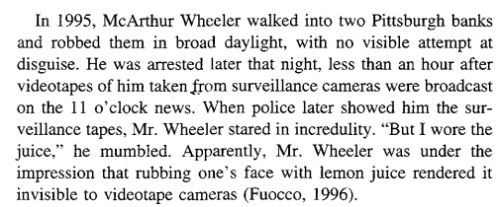
Wheeler thought this because lemon juice can be used as invisible ink. This anecdote comes from the beginning of the most readable academic article I’ve encountered1, which empirically shows how stupid people overestimate their own abilities and smart people underestimate their own abilities. This has been named the Dunning-Kruger Effect, after the authors, though I prefer to call it the Idiot-Genius Confidence Reversal,2 because it results in idiots having more confidence than warranted and geniuses having less.
In their experiments, Dunning and Kruger showed how this disconnect between perception and reality manifests across a wide range of areas, including humor3, logical reasoning, and grammar.
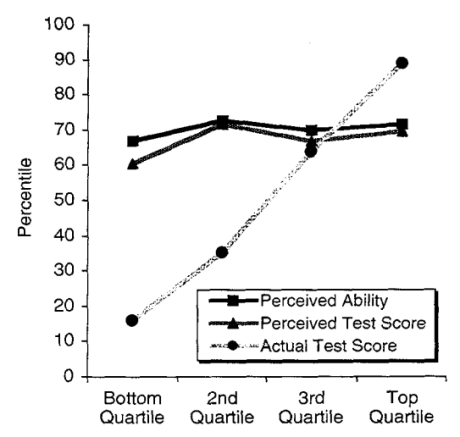
In all cases, a similar pattern emerged, where the worst performers were the most overconfident and the best performers the most underconfident, relative to their actual skill levels.
Can it be Good that Smart People Think They’re Dumber than They Are, and Stupid People Think They’re Smarter than They Are?
If smart people doubt themselves, they are less likely to speak up in a group setting than they objectively should (given the high expected value of whatever they have to say); conversely, the idiots are overeager to share their ideas, relative to how good their ideas are likely to be.
This doesn’t seem like it would create a productive group dynamic, but the less smart members of a group speak, the more time they have to listen to others and to think about what they are going to contribute.
The Idiot-Genius Confidence Reversal means smarties are more likely to doubt their own ideas, and thus be open to ideas that conflict with their own. Openness to new ideas and an ability to incorporate them into one’s way of thinking is itself an indication of intelligence.
Another manifestation of intelligence is being skilled at evaluating the merits of others’ ideas.4 Perhaps the best use of smart people is to evaluate and build on the ideas others put forth, rather than putting forth their own, and the Idiot-Genius Confidence Reversal creates a group dynamic conducive to this.
Alternatively, maybe this confidence mismatch gives the stupid more opportunities to reveal themselves as such to the rest of the group, which can also be advantageous to the species. As Abraham Lincoln so eloquently said:

Was I Stupid at My Last Meeting?
One aspect of modern life where the Idiot-Genius Confidence Reversal manifests is in meetings. Have you ever been to a meeting where the people speaking the most seemed to know the least about the subject? Have you ever talked at length without knowing what you were talking about?
If you answered yes to either of these questions, than you may have experienced the Idiot-Genius Confidence Reversal. To see whether you played the role of idiot or genius, think about a recent meeting in which you participated, and complete the diagnostic:

The ability to accurately answer these questions is subject to your own level of intelligence; thus, it is impossible to come to a legitimate conclusion without the help of someone smarter than you. To grade the exam, show your answers to this diagnostic to the smartest person you know, and ask for his or her opinion on where you fell on the idiot-genius spectrum.
Footnotes:
- Thanks, University of Colorado for putting that PDF on the internet! I assume the link is attribution enough, given that it is 2016. Maybe I missed the memo on this, but people don’t formally cite things on the Internet, do they?
- No offense meant, David Dunning and Justin Kruger, I am a big fan of your work!
- The least funny joke, according to the article: “Question: What is big as a man but weighs nothing? Answer: His shadow.” The most funny joke: “If a kid asks where rain comes from, I think it’s a cute thing to tell him ‘God is crying.’ And if he asks why God is crying, another cute thing is to tell him ‘probably because of something you did’.” Each of these was given a mean expert rating by professional comedians. In this instance mean meant “average” but it just as easily could mean that professional comedians are mean, as far as experts go.
- This ability involves metacognition, thinking about thinking. The are numerous meta-analyses on the subject of meta-cognition. It’s hard to think of something more meta.
 Intersections