

Imagine you live in a city where all of the attractions are evenly distributed on Main Street, and tourists pick hotels solely based on how close they are to the greatest number of attractions. If you were a hotel magnate, where is the ideal place on Main Street to build a hotel?
This scenario is similar to a question posed by Harold Hotelling in a 1929 paper1. According to his model, the best place to be is the middle of Main Street, so that you are as close to as many attractions as possible.

If the red hotel is in the center of Main Street, and the blue hotel pops up to the left of it, red will be closest to all the attractions to its right, and to half of the attractions in between it and the blue hotel. If the red hotel is in the middle, and there is only one other hotel in town, the red hotel will always be closer to a greater number of attractions, and will thus be better off.
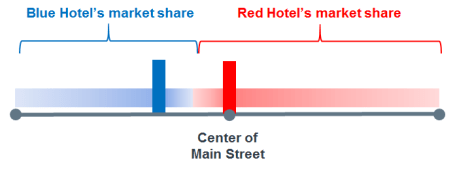
This type of line has been used to describe many different types of competition—from how companies should choose product attributes based on customer preferences, to how close Starbucks stores should be from one another, to how politicians should choose their political leanings. Imagine the the street as the distribution of voters on a spectrum from conservative to liberal and the hotels as political candidates.2 This is the situation in the US presidential election.
Assuming that there are exactly as many voters at every point on the ideological line3, the best place to be in the primary is in the center of your party. Often, a candidate’s strategy in the primary is to become acceptable to the greatest number of voters within their party.

In the general election, when there are only two candidates, the best place to be is in the center of the overall distribution, which is why you see so many candidates move to the center after they have been nominated.

Conventional wisdom today says that the Republican primary is a three-way horse race between Donald Trump, Marco Rubio and Ted Cruz. According to this article, which ranks every candidate’s policy positions on a scale from liberal to conservative, Trump is by far the least conservative of the three.
If you are Trump, which of the following two lines looks better to you?

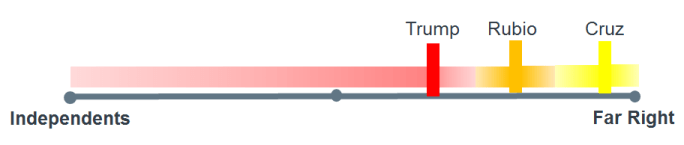
When Trump says things like “Muslims should not be allowed into the country,” it is an attempt to move further to the right. Whether he believes what he says or not, it is good strategy for winning the primary.
Footnotes:
- The paper is “Stability in Competition,” and I really wouldn’t recommend reading it unless you are into highly mathematical economic models.
- I mainly used this example because hotel and Hotelling sound alike, and Donald Trump owns a lot of hotels. Mnemonic devices are among my favorite types of intersections. Some of the best mnemonic device work I have seen occurred in my high school psychology class: The amygdala processes emotions because Queen Amidala is very emotional; the hippocampus processes memory because you would remember if there was a hippo on campus.
- These assumptions are not true in reality, which is the case for the assumptions underlying most economic theories. There are a number of factors a given candidate should consider when determining where to be on the political spectrum, including:
- The actual distribution of voters
- Where other politicians are on the line
- The relative propensity of voters at each part of the line to turn out
- His or her actual beliefs (last and usually least).
 Intersections